Scientific heritage
From fundamental science to new technical possibility.
DBRF draws inspiration from a scientific lineage associated with pioneering work in quantum electronics and molecular approaches to computation. The purpose of this heritage is not nostalgia; it is to preserve a way of working in which deep theory and practical invention reinforce one another.
Scientific lineage
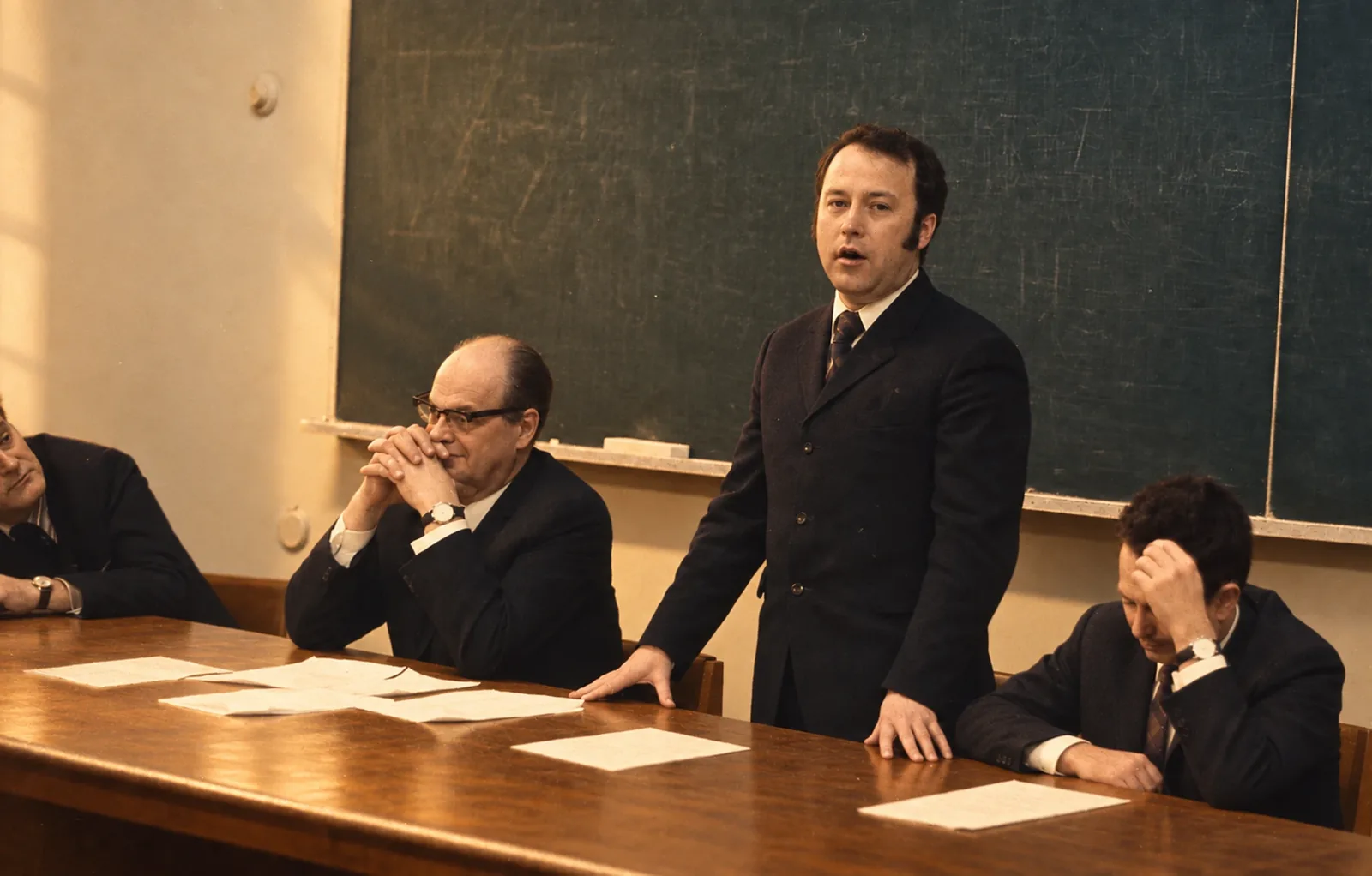
Four scientists at the frontier of coherent light
This photograph brings together four physicists whose work helped shape the development of quantum electronics, lasers and the study of coherent and nonlinear physical systems. Their research environment joined fundamental theory with experimental physics and engineering—an approach that continues to inform DBRF’s commitment to multidisciplinary science and working technology.
Aleksandr M. Prokhorov
Physicist · Nobel Prize in Physics, 1964
Prokhorov and Basov conducted foundational work in quantum electronics that led to oscillators and amplifiers based on the maser–laser principle. Their work helped establish the theoretical and experimental foundations of coherent electromagnetic generation.
Nikolay G. Basov
Physicist · Nobel Prize in Physics, 1964
Basov’s research extended from molecular generators and quantum radiophysics to lasers, semiconductor systems and the interaction of intense coherent radiation with matter. His scientific leadership helped establish a major research environment for laser physics at the P. N. Lebedev Physical Institute.
Anatoliy N. Oraevsky
Professor · Doctor of Physical and Mathematical Sciences
Oraevsky worked across molecular generators, laser physics, chemical lasers, laser chemistry and nonlinear dynamics. In 1963, Basov and Oraevsky showed how rapid processes with different molecular-energy relaxation rates could produce population inversion—a foundational contribution to the theory of chemical and gas-dynamic lasers.
His later work examined nonlinear single-mode laser behaviour, dynamical chaos, coherent states and the relationship between chemical reactions and laser parameters.
Yuri M. Popov
Professor · Doctor of Physical and Mathematical Sciences
Popov contributed to research on coherent light–matter interaction, self-induced transparency and semiconductor laser systems. His published work addressed phase-modulation effects, resonant pulse propagation and the development and applications of injection lasers.
Collective contribution
From quantum electronics to complex coherent systems
The work represented by these scientists spans several connected stages in the evolution of modern photonics: the principles of quantum amplification, molecular and semiconductor generation, chemical conversion into coherent radiation, resonant light–matter interaction and the nonlinear dynamics of laser systems.
- 01
Stimulated emission
Using controlled transitions between energy states to produce coherent radiation.
- 02
Quantum oscillation and amplification
Establishing the operating principles of generators and amplifiers based on quantum transitions.
- 03
Maser and laser systems
Translating quantum-electronic theory into coherent microwave and optical systems.
- 04
Chemical and semiconductor lasers
Extending coherent generation across molecular reactions and solid-state electronic structures.
- 05
Phase modulation and coherent interaction
Investigating how resonant pulses, phase and matter interact dynamically.
- 06
Nonlinear dynamics and synchronisation
Studying stability, self-organisation, modulation and chaotic regimes in laser systems.
Basov and Prokhorov shared half of the 1964 Nobel Prize in Physics, with the other half awarded to Charles H. Townes. The photograph identification is supplied by the DBRF archive and does not by itself establish a specific collaboration; not every technology listed was developed jointly by all four scientists.
Modern relevance
Coherence is still an engineering problem
Modern AI, communications, sensing and distributed computing operate in a very different technological environment, but they continue to depend on precise control of signals, phase, structure, timing and synchronisation. DBRF draws inspiration from this scientific tradition: understand the underlying dynamics, preserve meaningful structure and convert theory into systems that can be tested and used.
Their research in coherent generation, phase behaviour, laser stability and nonlinear dynamics forms part of the broader scientific foundation from which modern frequency control, signal synchronisation and precision timing technologies evolved.
This is a statement of scientific and methodological continuity. It does not claim that the individuals shown in the photograph developed today’s digital timing standards, AI architectures or DBRF technologies.
- The Nobel Prize in Physics 1964 — Nobel Prize
- Aleksandr M. Prokhorov — Nobel Prize facts
- Nicolay G. Basov — Nobel Prize facts
- 50 Years Since the Creation of the Laser — P. N. Lebedev Physical Institute
- Dynamics of Single-Mode Lasers and Dynamical Chaos — Anatoly N. Oraevsky
- Semiconductor Lasers — N. G. Basov, P. G. Eliseev and Yu. M. Popov
- Self-Induced Transparency Effect — I. A. Poluektov, Yu. M. Popov and V. S. Roitberg
- The Early History of the Injection Laser — Yu. M. Popov
Summaries above are original DBRF text. External sources open in a new tab.